
Sustainability Spotlight November 2026


Get Ahead of ESOS Before the Year Turns
Your Position on That Date Decides Whether You Qualify.
Here Is What to Check Before the Year Turns.
One date, quietly approaching, determines the next four years of energy compliance for thousands of UK organisations. On 31 December 2026, the government takes a snapshot. Whatever your headcount, turnover and balance sheet look like on that day decides whether your organisation qualifies for Phase 4 of the Energy Savings Opportunity Scheme, the mandatory energy assessment that large UK organisations must complete every four years, covering their buildings, industrial processes and transport.
It is an unusual kind of deadline, because nothing is actually due on the day itself. Nothing needs submitting, nothing needs signing. The date simply fixes your status, and everything that follows flows from it. That is exactly why it slips past organisations who were watching for a submission deadline instead.
Phase 4 also arrives with two meaningful changes.
The first closes a familiar shortcut: Display Energy Certificates and Green Deal assessments can no longer be used as alternative compliance routes. Organisations that relied on those previously will need an energy audit or ISO 50001 certification instead, which is a genuine shift in effort rather than a technicality.
The second change is the more interesting one. Phase 4 asks organisations to report progress against the commitments in their action plans, and to explain where those commitments have not been met. The scheme has quietly stopped being a one-off audit and become a cycle of accountability. Identifying savings is no longer enough. You are now expected to show what became of them.
There is a nearer date worth knowing about too. Organisations that qualified in Phase 3 must submit an annual progress update by 5 December 2026, signed off at board level and filed through the MESOS reporting system. That one is a matter of weeks away.
None of this is cause for alarm, and that is rather the point of this edition. The organisations that find ESOS straightforward are simply those who treat it as an ongoing process rather than a form to complete at the last moment. With the Phase 4 compliance deadline not until 5 December 2027, there is ample time to approach this calmly. What matters is knowing where you stand when the clock starts.
Why Early Preparation Pays Off
ESOS has an unfortunate reputation as a compliance exercise, which rather undersells it. The scheme exists because the savings it uncovers are generally worth considerably more than the assessment costs, and the organisations that engage with it properly tend to come away better off in several directions at once.
The first return is the obvious one. An ESOS assessment is a structured examination of where your energy goes across buildings, transport and processes, carried out by a qualified assessor who visits your sites. That is a genuinely valuable exercise regardless of the regulation behind it. Most organisations discover inefficiencies they had no idea about, and many of the recommended measures pay for themselves comfortably within the four year cycle.
The second return comes from the new progress reporting requirement, which quietly changes the incentive. When you know you will have to explain why a recommended measure was not implemented, those recommendations stop being a list that gets filed and start being a plan that gets delivered. Several of our clients have told us that the accountability element is the most useful thing about the new rules, because it gives sustainability work the internal visibility it had always lacked.
The third return is readiness. Phase 4 now allows participants to voluntarily include net zero considerations in their assessment, using the new BSI standards for energy and decarbonisation assessment. That is a clear signal of direction. Energy compliance and carbon management are converging, and organisations that already measure their carbon footprint properly will find they have most of the groundwork in place. The data overlaps substantially, which means the effort does too.

We see the same pattern with every compliance deadline. Treat ESOS as a single event in 2027 and it feels like pressure. Start gathering data now and it is just administration. The difference is almost entirely down to timing.
Start by working out where you will stand on 31 December. A large undertaking means 250 or more employees, or turnover above £44 million with a balance sheet total above £38 million. Corporate groups qualify if any UK member meets that definition, which catches more organisations than expected.
Here is where good carbon data earns its keep. The energy figures behind a credible carbon footprint are largely the same ones ESOS requires, covering the same buildings, vehicles and processes. Measure your emissions properly through the year and much of your ESOS preparation is already done. The hard part was never the assessment. It was assembling reliable data from across the business.
The two also strengthen each other. An ESOS audit finds costed opportunities to cut energy use. Carbon measurement tracks whether those savings actually materialised. Together they give you a documented cycle of finding savings, delivering them, and proving the result, which is exactly what Phase 4 now asks for.
So separate the regulation from the opportunity. ESOS is the prompt, but the value is in the data. Measure well, verify it independently, keep it current, and compliance becomes a by-product of good practice rather than a project of its own.

The Plastic Bag Was Meant to Save the Planet
The Surprising Story Behind “The Plastic Bag”
“Paper or plastic?”
It’s one of the most familiar questions at the checkout counter.
But here’s a fun fact: the plastic bag was invented to save the planet.
In the late 1950s, Swedish engineer Sten Gustaf Thulin designed a strong, lightweight plastic bag as an alternative to paper bags, which meant cutting down trees. His idea was simple: a bag tough enough to be used again and again. His son later said his father always carried one folded in his pocket.
The idea caught on everywhere. Before long, plastic bags were in nearly every shop and home around the world.
And honestly? The thinking behind it was a good thing.
But the story didn’t end there. Instead of being reused, most bags were used once, often for just a few minutes, and then thrown away. Over time, people started asking a bigger question.
If a product was designed to last, why are we treating it as disposable?
That question is now shaping how the world thinks about waste, from bag bans to refill stations to reusable everything.
Here’s the good news. Your choices really do matter. Bringing your own bag, reusing what you already have, and saying no to what you don’t need all add up.
And your voice matters just as much. Every time you support businesses that cut unnecessary packaging and offer reusable options, you help raise the bar for everyone.
Use it once? Think twice. Use it again? That’s the point.
That’s how real change happens.


Every ESOS cycle produces a document full of good ideas. Costed, practical, site-specific recommendations for using less energy. And in a great many organisations, that document gets filed, admired briefly, and never opened again. Designed to be used repeatedly, treated as single use.
Phase 4 changes that. You will now be asked what happened to the commitments in your action plan, and to explain where they were not met. So the most useful thing you can do between now and then is simple: start treating your action plan as a working document rather than a finished one.
That means pulling it out now, while there is still time to act, rather than next year when you are only reporting on it. Any measure you deliver between now and your submission becomes a progress story instead of an explanation. The plan was always meant to be used again. This is just the first cycle where someone checks.
Making Your Action Plan Work Harder:
- Find It and Open It
Locate your last ESOS report and action plan. For many organisations, simply reading it again surfaces measures that were agreed, approved and then quietly forgotten. - Mark What Actually Happened
Go through item by item: delivered, partly delivered, or not started. Record what each completed measure saved. This is the information Phase 4 asks for directly. - Pick the Quick Wins Now
Identify anything still outstanding that could realistically be delivered before your submission. Even one or two completed measures change the tone of your report considerably. - Write Down the Reasons
Where a measure was not taken forward, note why while the context is still fresh. Cost, disruption, a site closure, a better alternative. Honest reasons are perfectly acceptable; forgotten ones are harder to explain. - Give Each Measure an Owner
Recommendations without a named person rarely happen. A name and a date turns a suggestion into a commitment. - Keep It Live Between Cycles
Review the plan once or twice a year rather than once every four. The organisations that do this find their next assessment almost writes itself.

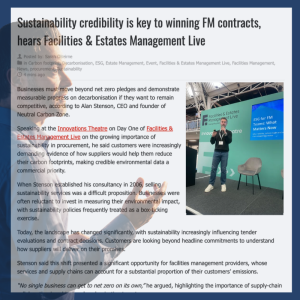
Our CEO and founder, Alan Stenson, spoke at the Innovations Theatre on day one of Facilities & Estates Management Live in London this October, and Facilities Management Journal covered the session.
His message to the room was a direct one. Businesses need to move beyond net zero pledges and demonstrate measurable progress if they want to stay competitive, because customers are increasingly asking for evidence of how suppliers will help reduce their footprints. Credible environmental data has become a commercial priority rather than a nice-to-have.
Alan reflected on how much has shifted since he founded the business in 2006, when persuading anyone to measure their impact was genuinely difficult and sustainability policies were often treated as a box-ticking exercise. Today the same data influences tender evaluations and contract decisions. He also cautioned against treating carbon reporting as an annual compliance task, arguing that a credible reduction strategy is worth more than a low footprint figure with no plan behind it. A point that sits rather neatly alongside this month’s ESOS theme.
The line that stayed with us: “No single business can get to net zero on its own.”
Read the full article on FMJ.

Compliance deadlines have a habit of feeling larger than they are. Approached early, ESOS Phase 4 is a structured opportunity to find savings, evidence progress and tidy up data that was always worth tidying. Approached late, it becomes a scramble. The clock starts on 31 December either way, and the only thing that changes is how ready you are when it does.
To every client, partner and reader who makes this community what it is, thank you. The progress you share with us is what fills these pages. If you have a success worth celebrating or a question worth exploring, we would love to hear from you, and it might just feature in a future edition.
If you would like a partner for the road ahead, our door is always open.
📩 [email protected]
Whether you qualify this time or not, the habit underneath it all is the same. Know where your energy goes, act on what you find, and keep a record of what changed. Everything else follows from that.
Thank you for reading. December’s edition is already brewing.
